Vintage Ephemera Junk Journal Kit Pattern
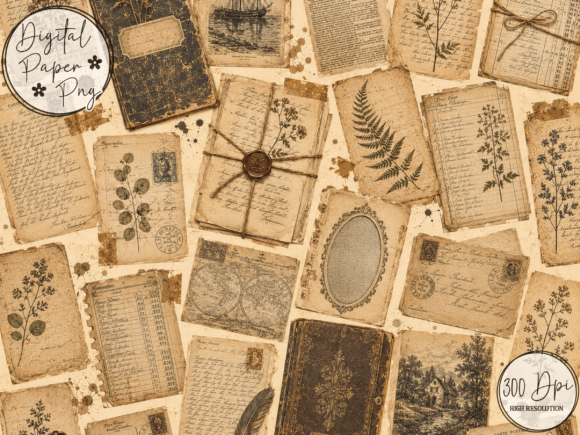
The Vintage Ephemera Junk Journal Kit Pattern is a high-resolution digital design asset—specifically, a 300 DPI PNG file with a transparent background—intended for use in creative projects that benefit from layered, tactile, or nostalgic visual texture. Unlike seamless tileable patterns, this pattern is non-seamless and designed for single-background application: it functions best as a full-page or full-layer backdrop rather than a repeating motif across large surfaces.
This pattern draws stylistically from vintage ephemera—think aged ledger paper, typewritten labels, faded postage stamps, botanical sketches, handwritten script, and distressed textures—all composited into a cohesive, balanced layout. Its resolution and transparency support both digital and print workflows, including scrapbooking, digital journaling, sublimation mockups, and print-on-demand stationery.
Why Consider This Pattern?
Designers and crafters often seek assets that reinforce thematic consistency without requiring extensive customization. The Vintage Ephemera Junk Journal Kit Pattern serves that need for projects rooted in nostalgia, storytelling, or handmade aesthetics. It’s especially relevant for those building cohesive kits—such as junk journal templates, printable planner pages, or themed digital scrapbook collections—where background texture contributes to perceived authenticity and depth.
Its 300 DPI resolution ensures fidelity in printed outputs, including letter-sized layouts or small-format booklets. The transparent background allows flexibility: users can overlay text, photos, or additional elements without needing to mask or erase background color, streamlining workflow in tools like Adobe Photoshop, Affinity Designer, or Canva.
Key Benefits and Realistic Expectations
Clarity and control: Because it’s a single, non-seamless pattern, users retain precise placement control. There’s no risk of visible tiling artifacts or unintended repetition—common concerns when scaling seamless patterns across irregular layouts.
Print readiness: At 300 DPI and full-size dimensions (typically matching standard page ratios like 8.5" × 11" or A4), the file supports professional-grade printing without upscaling or interpolation loss.
Licensing and usage: As a digital download intended for both personal and commercial use, it avoids physical shipping delays and inventory constraints. However, users should verify the specific license terms provided by the seller, particularly regarding attribution requirements or limitations on mass-produced physical goods.
What to expect—and not expect: This is not a vector file, nor does it include editable layers or source files. It cannot be resized infinitely without pixelation, and its non-seamless nature means it won’t tile across banners, textiles, or wallpaper without manual intervention. Color accuracy may vary slightly across screens and printers due to calibration differences—a common limitation with all RGB-based digital assets intended for CMYK output.
Situations Where This Pattern Is a Strong Fit
This pattern works well when your goal is to create a single-use, intentional background—for example:
- A cover page for a downloadable junk journal PDF kit
- A full-page background for a printable invitation suite with vintage typography
- A base layer in a digital collage for social media posts promoting artisanal crafts
- A textured backdrop for sublimation mockups of journals or notebooks
- A consistent visual anchor across a set of printable planner stickers or washi tape designs
In each case, the pattern adds contextual richness without competing with foreground content. Its deliberate imperfections—subtle grain, soft shadows, gentle fading—support a handcrafted aesthetic without demanding complex masking or blending techniques.
When Alternatives May Be More Suitable
If your project requires repeating texture across large or variable dimensions, a seamless pattern would offer more flexibility. For instance, designing fabric prints, website backgrounds, or packaging wraps often benefits from tileable assets that scale predictably.
Similarly, if you need granular control over individual elements—like isolating a single stamp or adjusting ink intensity—then a layered PSD or SVG collection would provide greater editing latitude than a flattened PNG.
For strictly digital-only use at smaller sizes (e.g., social media avatars or app icons), lower-resolution assets may suffice, making the 300 DPI specification less critical—and potentially over-specified for the use case.
Making an Informed Decision
To determine whether the Vintage Ephemera Junk Journal Kit Pattern aligns with your needs, consider these practical questions:
- What’s the primary output format? If you’re printing physical journals, invitations, or stationery—or preparing files for print-on-demand services—its 300 DPI resolution and transparency are functional advantages.
- Do you need repetition or variation? If your layout spans multiple pages or requires consistent texture across irregular shapes, a non-seamless pattern may require manual duplication and alignment, adding time to your process.
- How much editing do you anticipate? If you regularly adjust colors, contrast, or individual components, a flattened PNG limits options compared to layered or vector alternatives.
- Is thematic cohesion central to your project? If your audience responds to analog, archival, or handmade cues—such as educators creating printable history resources or indie publishers developing themed notebooks—this pattern reinforces that identity efficiently.
Finally, review sample previews carefully. Look for clarity in fine details (e.g., legibility of handwritten text, definition of paper fibers) and assess how the pattern interacts with potential overlays. Many creators test assets by placing semi-transparent text blocks or photo cutouts over the pattern to gauge contrast and readability before committing to full integration.
The Vintage Ephemera Junk Journal Kit Pattern is a purpose-built tool—not a universal solution. Its value lies in specificity: it meets defined needs around texture, theme, and print-ready quality without overpromising versatility. When matched thoughtfully to a project’s scope, output requirements, and aesthetic goals, it functions reliably as both foundation and finish.