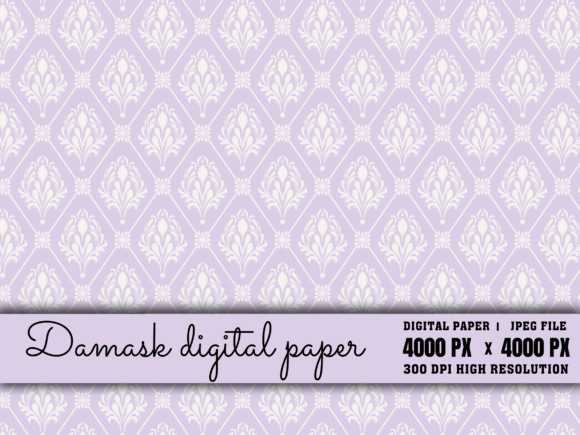
Damask Digital Paper Background: A Practical Guide for Designers and Crafters
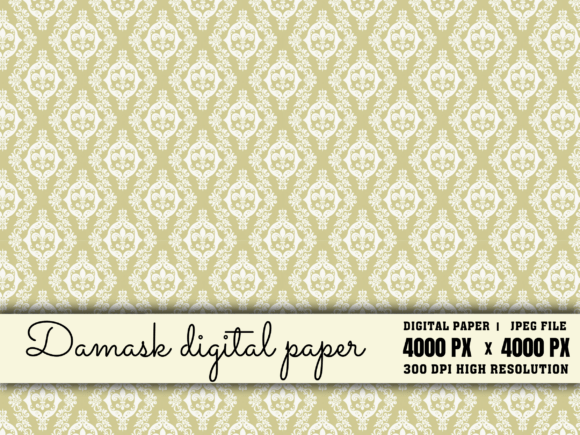
Damask digital paper background refers to a high-resolution, non-seamless pattern file designed specifically for digital and print-based creative work. Unlike tiled or repeating patterns, this version presents a single, self-contained damask motif—elegant, symmetrical, and rich in traditional textile heritage—rendered at 4000 × 4000 pixels and 300 DPI. It’s delivered as a JPG file via instant digital download, with no physical item shipped. Its resolution and format make it suitable for both close-up detail work (like planner stickers or invitation borders) and large-format output (such as fabric printing or sublimation transfers).
What Sets This Damask Digital Paper Background Apart
The defining trait of this particular Damask digital paper background is its intentional non-seamless construction. Most digital paper collections prioritize seamless tiling for effortless repetition across surfaces—but that isn’t always ideal. When designing invitations with centered focal elements, creating layered scrapbook pages where texture must recede naturally, or applying backgrounds to irregularly shaped planner tabs, a non-repeating layout offers greater compositional control. You’re not constrained by tile edges or forced alignment; instead, you have one cohesive visual field to crop, mask, or blend intentionally.
Its 4000 × 4000 pixel size at 300 DPI ensures fidelity across multiple use cases. At full size, it supports sharp letterpress-style prints on cardstock. When scaled down to 25% for digital stickers, it retains crisp line definition without pixelation. That same resolution translates reliably to fabric dye-sublimation workflows, where fine damask lines can otherwise blur or drop out at lower densities.
How It Compares With Other Digital Paper Options
Digital paper backgrounds fall into several functional categories—and understanding where Damask digital paper background fits helps clarify its appropriate role:
- Seamless damask patterns: Better for continuous surface coverage (e.g., wrapping paper design, website backgrounds), but require careful tiling setup in editing software and may draw attention to repeat lines if misaligned.
- Low-resolution JPEGs or PNGs (under 2400 px): Sufficient for social media graphics or web use, but unsuitable for professional print or textile applications where fine detail matters.
- Vector damask files (e.g., SVG or AI): Infinitely scalable and editable, yet often lack the subtle tonal variation and organic grain found in high-res raster interpretations—making them less ideal for realistic fabric simulation or vintage-inspired stationery.
- Photographic textures or scanned paper: Offer authenticity and tactile nuance but rarely include true damask structure; they’re more about surface character than intentional ornamental geometry.
This Damask digital paper background occupies a middle ground: it’s raster-based for rich tonal depth, resolution-optimized for real-world production, and structured enough to read clearly as damask—but not engineered for automatic tiling. That makes it especially useful when precision, intentionality, and print-ready clarity matter more than automation.
Strengths and Realistic Tradeoffs
Strengths include:
- Production-ready resolution: No upscaling needed for standard craft print sizes—from 2×2 inch stickers to 8.5×11 inch invitations or 12×12 scrapbook pages.
- Commercial-use licensing: Permits incorporation into products you sell, including printed stationery, sublimated apparel, or digital planner assets—provided the file itself isn’t redistributed as-is.
- Format simplicity: JPG is universally supported across design tools (Canva, Photoshop, Affinity Designer, Cricut Design Space) and requires no special plugins or conversion steps.
- Visual versatility: Works equally well as a full-page background, a cropped accent strip, or a masked overlay—its balanced contrast and moderate scale adapt without overwhelming.
Tradeoffs to consider:
- It is not vector-based, so individual motifs cannot be isolated or recolored without manual selection and masking—unlike layered PSD or SVG alternatives.
- Because it’s non-seamless, covering large areas (e.g., a 24×36 inch wall banner) would require careful compositing or supplemental design work—not drag-and-drop tiling.
- JPG compression means no transparency channel; if you need drop shadows or cut-out elements, you’ll need to add those separately in your editing software.
- As a digital-only product, there’s no physical sample to assess color accuracy or texture feel before purchase—so reviewing thumbnails and usage examples becomes more important.
Best-Fit Situations: When This Damask Digital Paper Background Makes Sense
This resource shines in projects where consistency, clarity, and controlled application are priorities. For example:
- A small-batch stationer designing wedding invitations might use the Damask digital paper background as a base layer beneath foil-stamped names—its even density prevents interference with metallic finishes, while its classic motif reinforces formality without competing visually.
- A digital planner creator building themed sticker kits could extract sections of the pattern to create delicate border elements or subtle page dividers—scaling portions individually to match icon sets without distortion.
- A textile designer prototyping fabric prints for scarves or home linens might import the file directly into their RIP software, confident that the 300 DPI resolution meets mill requirements for digital textile printing—no interpolation artifacts, no loss of motif integrity.
- An educator preparing printable classroom resources—like award certificates or vocabulary cards—can apply the Damask digital paper background as a refined alternative to generic clipart, lending visual cohesion without sacrificing readability.
When Another Option Might Be More Appropriate
If your workflow relies heavily on dynamic resizing or color customization—for instance, generating dozens of variations for an online store—you may find vector-based damask files more efficient over time, despite their flatter appearance. Similarly, if you're building a responsive website background or app UI element, a lightweight SVG or CSS-generated pattern would load faster and scale cleanly across devices—whereas this Damask digital paper background is optimized for static, fixed-dimension outputs.
For users just beginning with digital design tools, free or low-cost seamless pattern libraries may offer gentler learning curves—especially if tiling mechanics aren’t yet familiar. And if tactile realism is essential (e.g., simulating handmade paper with visible fibers or deckled edges), a hybrid approach—layering this Damask digital paper background over a scanned paper texture—often yields richer results than any single file alone.
Making an Informed Choice
Selecting the right digital paper background involves matching technical specs to practical needs—not just aesthetics. The Damask digital paper background stands out for its balance of resolution, motif fidelity, and ease of integration into common creative pipelines. It doesn’t replace vector flexibility or photographic realism, nor does it aim to. Instead, it fills a specific niche: high-fidelity, non-repeating, production-savvy damask imagery ready for immediate use.
Before downloading, ask yourself: Will I use this at full size or scaled? Do I need transparency or recoloring capability? Is my end output print-based, textile-based, or screen-based? Answering those questions honestly—not just scanning feature lists—helps determine whether this Damask digital paper background aligns with your actual workflow, rather than an idealized version of it.