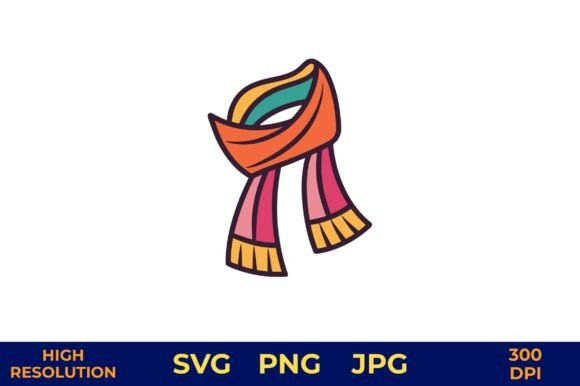
Striped Scarf Vector in Bold Colors
A Striped Scarf Vector in Bold Colors is more than a decorative asset—it’s a versatile, production-ready design element engineered for clarity, scalability, and visual impact. Built as a high-resolution vector (SVG) with matching PNG and JPG files—all at 4200px × 4200px and 300 dpi—this colorful winter scarf vector illustration delivers crisp edges, vibrant stripes, and a clean solid outline. Its transparent background ensures seamless integration across physical and digital applications, from printed wedding menus to social media banners. Unlike raster-only assets or low-res clipart, this design retains fidelity at any scale and adapts without distortion to diverse surfaces and formats.
Why Strategic Use Matters More Than Quantity
Many creators download dozens of vectors “just in case”—only to use fewer than 20% of them meaningfully. A Striped Scarf Vector in Bold Colors gains value not from how often it’s used, but from how intentionally it supports a specific objective. For example: a florist launching a holiday pop-up might use the scarf vector as a recurring motif on gift tags, Instagram story highlights, and table number cards—not because it’s festive, but because it reinforces brand warmth, rhythm, and seasonal cohesion. That consistency builds recognition faster than rotating unrelated graphics.
Similarly, educators designing winter-themed lesson kits benefit when the same bold-striped scarf appears across printable flashcards, classroom posters, and digital slide backgrounds. The repetition isn’t decorative; it acts as a subtle cognitive anchor—helping learners associate visual rhythm with thematic content. In both cases, the vector serves a functional role in communication architecture—not just aesthetics.
When This Design Delivers Measurable Outcomes
Timing and context determine whether a Striped Scarf Vector in Bold Colors strengthens your work—or dilutes it. It performs best when aligned with three conditions:
- Clarity of purpose: You know exactly where and why it will appear—e.g., as part of a cohesive “winter collection” branding system for a boutique, not as a generic filler on an unthemed blog post.
- Consistency in execution: You’re applying it alongside complementary colors, typography, and spacing—not mixing it with clashing patterns or inconsistent line weights.
- Control over output quality: You’re using the SVG version for print projects (like mugs or posters) and the high-DPI PNG for digital ads—ensuring resolution matches the medium’s requirements.
Without those conditions, even a technically excellent file can weaken perception. A mismatched stripe palette on a minimalist wedding invitation may unintentionally signal disorganization. A stretched JPG version on a large-format poster introduces visible pixelation—undermining professionalism before the message is read.
Practical Applications Across Real-World Roles
Freelancers and small business owners often overlook how much time they lose recreating simple seasonal assets. With a Striped Scarf Vector in Bold Colors, you pre-solve that problem: one download covers greeting cards, social banners, email headers, and product mockups. No need to re-color, resize, or trace—just place, adjust opacity if needed, and export. That efficiency compounds across client projects, especially during peak seasons like holidays or bridal fairs.
Photographers and planners use it to add subtle thematic texture without overshadowing subjects. Overlaying a low-opacity scarf vector behind a flat-lay photo of wedding stationery creates depth and seasonality—without competing with text or photography. Because the outline is solid and stripes are evenly spaced, it reads clearly even at small sizes (e.g., on RSVP cards or digital seating charts).
Educators and hobbyists find utility in its adaptability for tactile learning tools. Print the vector on cardstock, cut out individual stripes, and use them for color-matching games, pattern sequencing, or textile design lessons. The 300 dpi resolution ensures clean cuts and legible detail—even after laminating or repeated handling.
What to Consider Before Integration
Before embedding the Striped Scarf Vector in Bold Colors into your workflow, ask two strategic questions:
- Does this reinforce—or distract from—the primary action or message? If you’re designing a “Save the Date” card, the scarf should support urgency and celebration—not compete with names, dates, or venue details. Test visibility: blur your screen slightly. Does the hierarchy remain intact?
- Is the color contrast appropriate for accessibility and environment? Bold doesn’t mean illegible. Vibrant stripes may reduce readability when placed over busy backgrounds or on low-contrast screens. Always verify text overlays against WCAG 2.1 contrast ratios—especially for digital use cases like social posts or email headers.
Also note licensing scope: while personal and commercial use is permitted, redistribution (e.g., reselling the vector as part of a template pack) requires explicit permission. Most users don’t need that—but agencies bundling assets for clients should verify terms upfront.
Risks of Context-Free Usage
Using a Striped Scarf Vector in Bold Colors without clear intent risks visual fatigue and diminished impact. Repeating the same stripe sequence across every touchpoint—website, packaging, invoices, social bios—can flatten differentiation. Overuse signals reliance on decoration over strategy. Worse, deploying it outside seasonal relevance (e.g., on a spring launch campaign) creates subtle dissonance that audiences register intuitively, even if unconsciously.
Another underappreciated risk is technical misapplication. Resizing the JPG version beyond its native dimensions for large prints introduces blurriness no amount of sharpening fixes. Relying solely on the PNG for web use—without optimizing file size—slows page load times, affecting SEO and bounce rates. These aren’t flaws in the asset; they’re gaps in deployment planning.
How to Use It Intentionally—Not Automatically
Start with restraint. Limit usage to no more than three distinct contexts per campaign or season. For example: a boutique might use the scarf vector on (1) holiday gift tags, (2) Instagram carousel slides announcing promotions, and (3) the header of a printable “Winter Lookbook” PDF. Each instance serves a defined function—identification, engagement, and education—and shares consistent sizing, placement logic, and color treatment.
Next, build around it—not on top of it. Choose fonts and secondary graphics that echo its rhythm: a sans-serif with strong vertical strokes complements bold horizontal stripes; geometric icons align better than organic hand-drawn ones. That alignment signals intentionality—not coincidence.
Finally, track usage outcomes. Did invitations featuring the scarf see higher response rates? Did social posts with the vector generate more saves or shares? Correlate design choices with measurable behavior—not assumptions. That data sharpens future decisions far more than trend reports ever could.
Long-Term Value Beyond the Download
The immediate utility of a Striped Scarf Vector in Bold Colors lies in its readiness—but its enduring value emerges through reuse discipline and contextual evolution. A photographer might rotate its orientation (vertical vs. horizontal) to match different aspect ratios across platforms. A planner could recolor individual stripes to align with changing client palettes—using the SVG’s editable layers rather than starting from scratch each time.
That flexibility transforms a static asset into a modular component—a building block rather than a finished piece. Over time, it becomes part of your visual vocabulary: recognizable, reliable, and responsive. And because it’s delivered in multiple formats with transparent backgrounds, it integrates cleanly into evolving toolchains—from Canva templates to Adobe Illustrator workflows to print-on-demand dashboards.
Ultimately, the strength of the Striped Scarf Vector in Bold Colors isn’t in its vibrancy alone, but in how thoughtfully it serves your goals—whether that’s strengthening brand recall, simplifying production, supporting learning, or elevating customer experience. Used with clarity and care, it earns its place—not as decoration, but as infrastructure.