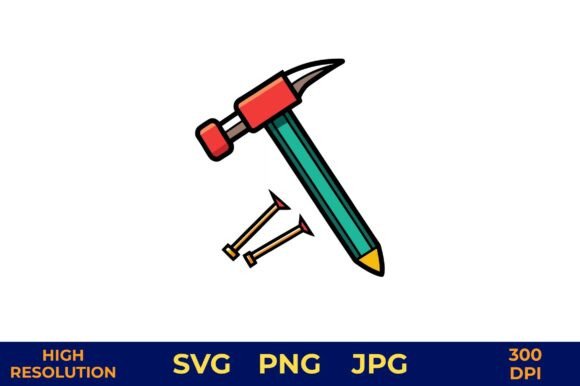
Hammer and Nails for Building Tools
At first glance, Hammer and Nails for Building Tools appears to be a straightforward vector illustration—clean lines, bold shapes, vivid color contrast, and unmistakable utility. But its real strategic value lies not in what it depicts, but in how deliberately it can be applied across diverse professional and creative contexts. This isn’t just clipart. It’s a precision-crafted visual asset designed to support intentionality: in branding, communication, product development, and audience engagement.
Why Visual Precision Matters in Decision-Making
Every time you choose a visual element—especially one as symbolically resonant as a hammer and nails—you’re making a quiet but consequential decision about tone, credibility, and clarity. A well-executed vector like Hammer and Nails for Building Tools carries implicit meaning: craftsmanship, structure, repair, foundation-building. That resonance transfers directly to your materials—whether you're designing a contractor’s business card, a DIY workshop handout, or a construction startup’s social media banner.
Unlike generic stock icons, this set is built for versatility without compromise: SVG for infinite scalability, PNG and JPG with transparent backgrounds, and a generous 4200px × 4200px canvas at 300 dpi. That means it holds up on a trade show poster, scales cleanly into a mobile app icon, and retains fidelity when printed on fabric for branded workwear. The technical specs aren’t arbitrary—they reflect real-world production needs.
Strategic Use Cases Beyond Decoration
Think of Hammer and Nails for Building Tools as infrastructure—not decoration. Here’s how professionals apply it with purpose:
- Branding & Positioning: A roofing company uses the hammer motif subtly in its logo lockup—not as literal imagery, but as a stylized negative space within the letter “H.” It signals expertise without cliché.
- Customer Experience Design: A home repair subscription service includes a printable “Toolbox Checklist” PDF featuring the vector. Customers download, print, and hang it in their garage—reinforcing brand presence through utility, not promotion.
- Educational Materials: A vocational instructor integrates the illustration into a laminated “Fastener Identification Guide” for students. The consistent visual language reduces cognitive load during hands-on training.
- Product Development: A small-batch ceramics studio prints the design onto limited-edition mugs sold at local builders’ expos—cross-pollinating audiences while honoring shared values of making and mending.
Notice what’s absent from these examples: forced relevance or decorative overuse. Each application serves a functional outcome—clarity, retention, trust, or action. That’s the difference between using an asset and deploying it.
When to Reach for Hammer and Nails—and When to Pause
This vector excels when your goal requires immediate recognition, grounded authority, or tactile authenticity. It works especially well in industries where competence is demonstrated through action—not just appearance: construction, skilled trades, hardware retail, maker education, restoration services, and even organizational development (e.g., “building team capacity” or “hammering out a plan”).
But context dictates appropriateness. Avoid it when:
- Your audience associates hammers with outdated methods rather than skilled craft—particularly in highly digitized or automated sectors.
- You’re communicating abstract concepts like data strategy or AI ethics, where concrete tool metaphors may oversimplify or mislead.
- Brand voice prioritizes minimalism, fluidity, or abstraction—where sharp edges and literal forms clash with established visual grammar.
Ask yourself: Does this image clarify—or does it assume? Does it invite participation—or signal hierarchy? Hammer and Nails for Building Tools gains power when paired with clear intent, not just aesthetic preference.
Practical Integration: From Download to Delivery
You’ll receive one high-resolution file package—but how you use each format determines long-term value. Here’s how seasoned creators allocate them:
- SVG first: Import into Figma, Illustrator, or Canva to recolor, resize, or layer without quality loss. Ideal for web banners, interactive PDFs, or dynamic email headers that adapt across devices.
- PNG with transparency: Drop directly into social templates (Instagram carousels, Pinterest pins) or layered mockups (e.g., placing the hammer on a photo of a finished deck). No background cleanup needed.
- JPG at 300 dpi: Reserve for physical output—brochures, signage, or printed kits. Its resolution ensures crisp detail even at large sizes, avoiding pixelation during offset printing.
Pro tip: Rename files meaningfully before organizing—e.g., hammer-nails-brand-primary-blue.svg instead of download-32948.png. Future-you (or your team) will save hours during asset audits or client handoffs.
Risks of Unintentional Use
Without alignment to goals, even strong visuals dilute impact. Common pitfalls include:
- Visual fatigue: Repeating the same hammer graphic across every social post without variation or narrative progression trains audiences to scroll past it.
- Tone mismatch: Using a bright, playful version of Hammer and Nails for Building Tools in a serious safety compliance document undermines gravity and credibility.
- Legal ambiguity: Assuming “just download and print” covers all commercial uses. While this asset permits broad application—from mugs to wedding menus—it doesn’t extend to resale as standalone digital art or trademark registration. Always verify license scope before white-label distribution.
These aren’t limitations of the file itself—they’re reminders that tools only amplify existing strategy. A hammer doesn’t build a house; it helps someone who knows where to strike, how hard, and why.
Long-Term Value: Beyond the First Print
The highest ROI on Hammer and Nails for Building Tools emerges over time—not in isolated projects, but in systems. Consider building reusable templates around it:
- A standardized “Project Milestone” badge series for internal teams—each stage marked by a modified version (e.g., hammer upright for “planning,” angled for “execution,” resting on nails for “completion”).
- A modular workshop kit: same vector reused across handouts, slide decks, and QR-linked video demos—creating continuity across learning touchpoints.
- A seasonal campaign framework: “Spring Repair Series,” “Fall Foundation Check,” “Winter Weatherproofing”—anchored visually by consistent hammer/nail styling, varying only color and supporting text.
This kind of repetition builds recognition without redundancy. It transforms a single asset into a connective thread—linking messages, mediums, and moments under a coherent logic.
Final Thought: Tools Serve Purpose—Not the Other Way Around
Hammer and Nails for Building Tools is valuable because it’s both specific and flexible—rooted in tangible meaning, yet adaptable to abstract goals. Its strength isn’t in being everywhere, but in appearing where it earns attention: on a planner page that helps a freelancer track project phases, on a mug that starts conversations at a trades conference, or in a wedding menu that quietly honors the couple’s shared love of restoring old homes.
That level of resonance doesn’t come from downloading a file. It comes from asking, before you place the image: What am I helping someone understand, remember, or do? When your answer is clear—the hammer lands true.