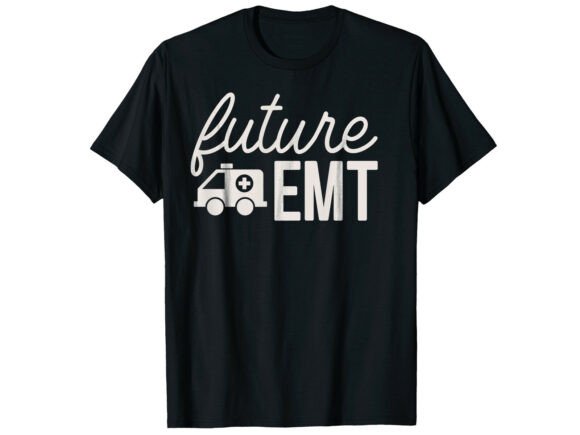
Future EMT Dreamer Paramedic T-Shirt
The Future EMT Dreamer Paramedic T-Shirt is a digitally delivered design file package intended for personal or small-scale use in printing and crafting. It features a clean, minimalist ambulance icon paired with bold, legible typography conveying aspiration—specifically, the path toward becoming an EMT or paramedic. Unlike mass-produced apparel, this offering provides source files (EPS, SVG, PNG) optimized for high-resolution output (4500×5400 pixels at 300 dpi), all with transparent backgrounds and full color-editability.
This design appeals primarily to individuals engaged in emergency medical services (EMS) education or early career development: EMT students, paramedic trainees, clinical interns, and pre-health learners exploring first responder pathways. It may also resonate with educators, program coordinators, or EMS instructors seeking cohesive visual identity for cohorts or training events. The core value lies not in ready-to-wear clothing, but in flexible, professional-grade assets that support self-expression, peer recognition, or program branding.
One key benefit is adaptability. With editable vector (EPS, SVG) and high-res raster (PNG) files included, users can adjust colors to match school uniforms, team palettes, or personal preferences without loss of quality. The transparent background allows seamless application across diverse physical products—T-shirts, hoodies, mugs, stickers, tote bags, tumblers, phone cases, notebook covers, and wall art—without requiring additional graphic editing skills. For learners building portfolios or preparing for clinical rotations, having a consistent, polished visual marker of their commitment can reinforce professional identity during formative stages.
However, important tradeoffs exist. This is not a physical product: no garment, mug, or sticker ships upon purchase. Users must handle printing themselves—or work with a third-party service—which introduces variables like fabric type, print method (e.g., screen printing vs. direct-to-garment), color accuracy, and durability. File compatibility also requires basic familiarity with design software (e.g., Adobe Illustrator, Inkscape, or Canva) to modify colors or scale appropriately. Those unfamiliar with vector formats or resolution requirements may face a learning curve before achieving desired results.
Another consideration is context of use. While the design communicates clear intent—supporting EMS career aspirations—it uses generic iconography and typography rather than institution-specific logos, certification seals, or accredited program identifiers. That makes it suitable for informal or motivational use but less appropriate where official affiliation or regulatory compliance matters (e.g., clinical field placements requiring approved uniforms). Similarly, because it lacks licensing or endorsement from national EMS organizations (e.g., NREMT, NAEMT) or academic institutions, it should not be interpreted as evidence of certification, training status, or professional standing.
The Future EMT Dreamer Paramedic T-Shirt is a strong fit when the goal is low-cost, customizable expression of professional intent—particularly for individuals who already have access to printing resources or plan to order items through local vendors or online print-on-demand platforms. It supports cohort-building among peers in the same training cycle, serves as a conversation starter during informational interviews or job shadowing, or functions as a tangible milestone marker after completing foundational coursework or skills labs. Its simplicity and clarity make it especially useful for those prioritizing readability and broad recognizability over intricate detail or niche symbolism.
Conversely, alternatives may be preferable in several situations. If immediate, ready-to-wear apparel is needed—for example, for an upcoming orientation event or clinical observation day—purchasing a pre-printed shirt from an EMS gear retailer may offer faster turnaround and guaranteed fit/quality. For learners affiliated with a specific training program or college, officially licensed merchandise (e.g., branded polos or jackets bearing the institution’s name and seal) often carries greater formal recognition and may align better with dress codes. Likewise, those seeking designs grounded in real-world EMS practice—such as anatomical illustrations, drug dosage charts, or ACLS algorithm visuals—may find discipline-specific educational graphics more functionally relevant than aspirational slogans.
Practical decision-making starts with clarifying purpose. Ask: Is this for personal motivation, peer connection, or external representation? Does the intended use require official affiliation, or is symbolic alignment sufficient? What printing options are realistically available—and do they support vector-based inputs and color customization? If the answer points toward flexibility, control, and iterative use across multiple item types, the Future EMT Dreamer Paramedic T-Shirt file set offers measurable utility. If speed, standardization, or institutional validation are higher priorities, evaluating vendor-printed alternatives or program-authorized gear becomes more appropriate.
It’s also worth noting that while the design centers on “future” roles, its relevance extends beyond students. Career-changers entering EMS from other fields, veterans transitioning into healthcare, or volunteers advancing through certification levels may find the imagery affirming—not as a placeholder for credentials, but as acknowledgment of deliberate, ongoing preparation. That broader applicability adds to its practical longevity, provided expectations around file-based delivery and user responsibility remain clear.
In summary, the Future EMT Dreamer Paramedic T-Shirt is a tool—not a credential, not apparel, but a customizable visual asset. Its usefulness depends less on the design itself and more on how well it integrates with the user’s existing resources, goals, and understanding of EMS professional development. When matched thoughtfully to need, it supports intentionality; when mismatched, it risks sitting unused in a downloads folder. Evaluating fit begins with honest assessment of both technical capacity and professional context—not just what the design says, but what role it’s meant to play.