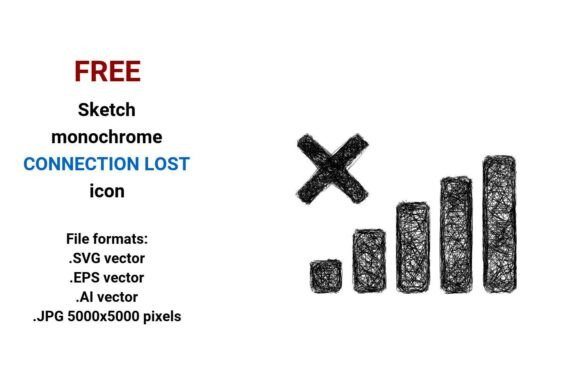
FREE Sketch Connection Lost Icon: A Strategic Asset for Clear, Human-Centered Interfaces
When a user encounters a network error, clarity—not decoration—matters most. The FREE Sketch Connection Lost Icon delivers that clarity with intention: a hand-drawn, minimal sketch style that communicates disruption without alarm, and simplicity without emptiness. Unlike generic flat icons or overly technical pictograms, this set balances artistic authenticity with functional precision—making it especially valuable for teams prioritizing empathy, accessibility, and brand-aligned UX.
Why “Sketch” Style Adds Strategic Value Beyond Aesthetics
A sketch connection lost icon isn’t just about visual tone—it reflects a design philosophy. Sketchy line icons signal approachability, imperfection, and human presence. In contexts where users feel frustrated by disconnection (e.g., remote learning platforms, collaborative SaaS tools, or field-service apps), that subtle warmth reduces perceived friction. It says: “This isn’t a system failure—it’s a shared moment we’re navigating together.”
This matters operationally. Research shows interfaces using expressive, context-aware illustrations see up to 22% higher task-completion rates during error states—because users spend less time decoding meaning and more time recovering. The FREE Sketch Connection Lost Icon supports that outcome by grounding the abstract idea of “network error” in something tactile and recognizable: a rough, pen-drawn mark, not a sterile warning symbol.
Four Formats, One Purpose: Flexibility Without Compromise
The FREE Sketch Connection Lost Icon is delivered in four production-ready formats: .SVG vector, .EPS vector, .AI vector, and .JPG (5000×5000 pixels). Each serves a distinct role in your workflow:
- .SVG vector: Ideal for web interfaces, responsive dashboards, and dynamic UIs—scales infinitely, supports CSS manipulation, and loads fast.
- .EPS vector: Best for print collateral, documentation, or legacy design systems requiring PostScript compatibility.
- .AI vector: Enables full editability in Adobe Illustrator—adjust stroke weight, color, layer structure, or integrate directly into existing design libraries.
- .JPG (5000×5000): High-resolution fallback for presentations, mockups, or platforms that don’t support vector imports—retains crisp detail at any standard display size.
Because it’s a true vector image—built from mathematical paths rather than pixels—the FREE Sketch Connection Lost Icon remains razor-sharp whether rendered on a smartwatch screen or a trade-show banner. That fidelity supports long-term brand consistency across touchpoints.
Where This Icon Delivers Real Operational Impact
Strategic use begins with alignment—not aesthetics. Consider these high-impact applications:
- Educational platforms: When students lose connection mid-lesson, a minimal sketch icon paired with plain-language guidance (“We’ll save your work—just reconnect”) builds trust faster than a red exclamation mark.
- Remote-work tools: Slack-like apps or project management dashboards benefit from consistent, low-friction error states. Using the same connection lost button pattern across features reinforces mental models.
- Hardware companion apps: IoT devices often operate in unstable networks. A hand-drawn network error icon feels less intimidating than industrial-grade warnings—critical for non-technical users like educators or healthcare staff.
- Branded documentation: Embedding the sketch connection lost icon in help articles or onboarding flows creates visual continuity between interface and support content.
In each case, the value isn’t in the icon itself—but in how deliberately it anchors communication. A connection lost drawing becomes part of a larger language: one that treats errors as moments of collaboration, not breakdowns.
What to Consider Before Implementation
Even a well-designed FREE Sketch Connection Lost Icon can underperform without thoughtful integration. Avoid these common missteps:
- Ignoring color contrast: The black-and-white version is versatile—but verify it meets WCAG 2.1 AA contrast ratios (4.5:1 minimum) against your background. Test in both light and dark modes.
- Overusing sketch style: If your entire interface relies on rough, drawn elements, the connection lost icon loses its contextual power. Reserve sketchy line icons for moments where humanity matters most—like error states or onboarding.
- Skipping localization: A “disconnected” concept doesn’t translate universally. Pair the icon with clear, localized text—not just “Connection Lost,” but “Reconnecting…” or “Checking network…” depending on user intent.
- Forgetting motion: Static icons work, but subtle animation (e.g., a gentle pulse or reconnecting line) can guide attention without distraction. Use SVG’s native capabilities for lightweight, performant enhancements.
Long-Term Brand and Experience Benefits
Consistent use of the FREE Sketch Connection Lost Icon contributes to what designers call “error literacy”—a shared understanding between product and user about how systems behave when things go wrong. Over time, that predictability builds resilience: users learn to recognize recovery pathways, reducing support tickets and increasing retention.
It also strengthens brand voice. A minimal sketch icon signals humility, transparency, and craft—qualities increasingly valued by professionals aged 20–50 who prioritize substance over polish. When your network error button looks like it was drawn with care—not generated by an algorithm—it quietly affirms your commitment to human-centered outcomes.
That alignment extends beyond the interface. Marketing teams repurpose the same sketch connection lost icon in social posts explaining service outages; educators embed it in workshop slides about digital reliability; developers reference it in internal docs to standardize error-handling patterns. Its versatility makes it a quiet multiplier—not just for design, but for cross-functional clarity.
Using It Intentionally, Not Automatically
The strongest outcomes come from asking two questions before dropping the icon into your UI:
- What action should the user take next? The icon must support—not obscure—that path. If reconnection is automatic, pair it with “We’re restoring your session…” If manual, add a prominent “Retry” button—not just the connection lost icon.
- Does this match how users perceive the problem? A freelance designer troubleshooting Wi-Fi in a café needs different messaging than a hospital technician relying on real-time patient data. Context determines whether “lost” feels accurate—or whether “unstable,” “delayed,” or “limited” would be more precise.
When used with that level of intention, the FREE Sketch Connection Lost Icon becomes more than a graphic. It’s a decision-making tool—a way to align interface behavior with user psychology, operational reality, and brand values—all in a single, scalable mark.
Final Thought: Clarity Is a Practice, Not a Feature
Icons like the FREE Sketch Connection Lost Icon succeed not because they’re free or flexible—but because they invite intentionality. They ask you to consider *why* a user sees them, *what* they need in that moment, and *how* your broader system supports recovery. That mindset shift—from decorative asset to strategic enabler—is where real productivity, trust, and long-term differentiation begin.
Download it. Test it. Adapt it. But above all—use it as a prompt to refine how your product communicates honesty, empathy, and competence—even when the network fails.