FREE Sketch Checkout Page Icon: A Practical Resource for UI Designers and Developers
Designing a checkout experience that feels both trustworthy and human-centered is a persistent challenge. One subtle but effective way to add warmth and approachability is through handdrawn or sketch-style interface elements — especially for high-intent actions like completing a purchase. The FREE Sketch Checkout Page Icon fills this niche: a deliberately rough, monochrome, vector-based icon set representing the checkout page or button in a doodle-style aesthetic. It’s not photorealistic, nor is it sleek and minimalist — it’s intentionally sketched, with visible line variation, slight imperfections, and organic curves that suggest human authorship.
What Makes This FREE Sketch Checkout Page Icon Distinct?
Unlike many stock icons that prioritize polish over personality, this resource leans into its sketched identity. It’s delivered in four formats: .SVG, .EPS, .AI, and .JPG (5000×5000 pixels). That format range matters — SVG and EPS are resolution-independent vector formats ideal for responsive web interfaces; AI files support deep editing in Adobe Illustrator; and the high-res JPG offers immediate use in mockups, presentations, or printed documentation where vector editing isn’t needed.
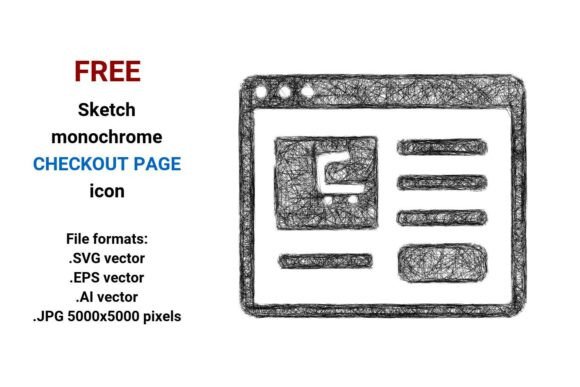
The icon itself depicts a simplified checkout screen: a stylized browser window frame containing key visual cues — a cart symbol, a price tag, and an abstract “submit” or “confirm” shape — all rendered in continuous, handdrawn line work. Its monochrome black-and-white treatment ensures contrast flexibility and easy recoloring in design tools. Because it’s built as a vector image — defined by mathematical points, lines, and curves — it scales cleanly from a 16-pixel favicon to a full-screen banner without pixelation or loss of fidelity.
How It Fits Into Broader UI Design Workflows
UI designers often choose between three broad categories of icons: polished system icons (like Material or Fluent), expressive illustrated icons (often used in marketing or onboarding), and handdrawn or sketch-style icons like this one. The FREE Sketch Checkout Page Icon belongs squarely in the third group — and serves a specific communicative purpose. It signals informality, creativity, or a “work-in-progress” mindset. You’ll see this style used effectively in prototype wireframes, internal pitch decks, educational toolkits, or SaaS dashboards where users benefit from visual cues that feel less transactional and more collaborative.
Compared to editable sketch icons sourced from design marketplaces, this version stands out for its licensing clarity (truly free for personal and commercial use) and intentional minimalism. It avoids decorative flourishes or excessive detail — making it easier to adapt, layer, or pair with other sketch UI elements like sketch button, checkout page button, or handdrawn checkout page icon variants. Its roughness is consistent, not random — meaning multiple icons from the same toolkit will visually harmonize.
When This Icon Works Well — and When It Doesn’t
This FREE Sketch Checkout Page Icon is strongest in contexts where tone and user psychology matter as much as function. For example:
- A fintech startup building a financial literacy app might use it in tutorial screens to soften the perceived complexity of payment steps.
- A design agency creating low-fidelity clickable prototypes may embed it to signal “this is exploratory” — helping stakeholders focus on flow over final styling.
- An educator preparing a UI/UX workshop could include it in a sketch toolkit alongside other editable sketch icon assets to teach vector manipulation and visual hierarchy.
However, it’s less appropriate where clarity, speed, or regulatory expectations dominate. E-commerce sites targeting older demographics or users with low digital confidence often benefit from highly legible, standardized icons — not interpretive line art. Similarly, enterprise applications requiring strict brand consistency across dozens of touchpoints may find the doodle style icon too informal for production use without significant adaptation.
Practical Format Considerations Across Use Cases
The inclusion of four file formats gives users real flexibility — but each serves different needs:
- .SVG: Best for live websites and web apps. Easily embedded, scalable, supports CSS styling (e.g., stroke color changes), and accessible via
aria-label. - .EPS: Ideal for print collateral or legacy design workflows. Widely supported across vector editors, though less common in modern web pipelines.
- .AI: Enables full layer control, path editing, and integration into larger Illustrator-based design systems — useful if you’re building a custom sketch UI element library.
- .JPG (5000×5000): Serves well for high-fidelity mockups, investor decks, or documentation where vector editing isn’t required — but avoid using it for responsive interfaces, as raster images don’t scale cleanly.
Note: While the JPG version is large, it remains a fixed-resolution bitmap. If your project demands dynamic resizing (e.g., dark mode toggles that adjust stroke weight), vector formats are the only reliable choice.
Comparing Style Choices: Sketch vs. Other Visual Approaches
Choosing a sketch line icon over alternatives involves tradeoffs beyond aesthetics. A clean, geometric checkout icon communicates efficiency and reliability. A flat-color icon conveys modernity and simplicity. A handdrawn vector icon, by contrast, introduces narrative texture — suggesting iteration, collaboration, or accessibility. It can reduce perceived friction, especially in early-stage products or learning environments.
That said, consistency matters. Mixing a rough checkout icon with highly polished navigation icons elsewhere in the interface may unintentionally signal uneven design maturity. If you adopt this FREE Sketch Checkout Page Icon, consider whether other UI components — buttons, form fields, or status indicators — would benefit from matching treatment. Many teams use such icons selectively (e.g., only in onboarding or error states) rather than system-wide.
Realistic Integration Examples
In practice, designers use this asset in ways that reflect actual constraints and goals. One team building a no-code platform included the checkout screen icon in their drag-and-drop component library — not as a final UI element, but as a placeholder that signaled “this area handles payment.” Another used the sketch checkout page button in a user-testing script to gauge how quickly participants associated the icon with “complete order,” finding it performed comparably to standard cart icons among creative professionals but slightly slower among general users unfamiliar with sketch UI conventions.
These examples highlight a key point: the value of the FREE Sketch Checkout Page Icon lies less in universal recognition and more in intentional communication. It’s a tool for shaping perception — not just labeling function.
Making an Informed Choice
If your goal is fast implementation, maximum compatibility, and broad familiarity, standardized icon sets remain the pragmatic default. But if you’re aiming to differentiate tone, reinforce a human-centered message, or support iterative design processes, this FREE Sketch Checkout Page Icon offers tangible benefits — especially given its open availability and versatile format support.
Before downloading, ask: Does this align with your audience’s expectations? Does it complement your existing visual language — or require additional assets to feel cohesive? And most importantly: does it serve a clear purpose beyond being “interesting”? When used thoughtfully, it’s more than a pictogram — it’s a small but deliberate part of how users understand what happens next.