Colouring Pages Chester Old Times
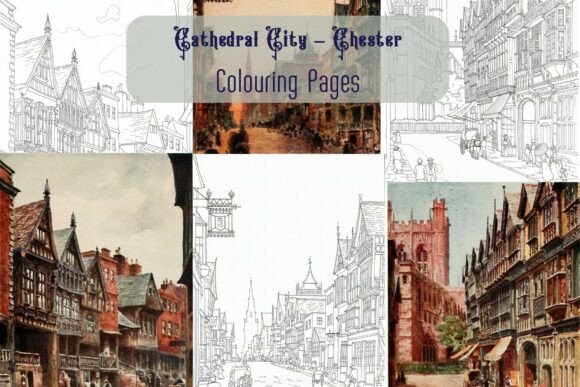
Colouring Pages Chester Old Times is a carefully curated digital resource featuring line-art interpretations of William W. Collins’ original 1905 illustrations from The Cathedral Cities of England. Focused exclusively on Chester, this set bridges historical documentation and contemporary creative practice—offering both visual reference and hands-on engagement with the city’s architectural heritage. Unlike generic colouring collections, it draws directly from a specific, publicly documented source: Collins’ evocative pen-and-ink depictions of Chester’s medieval walls, St. John the Baptist Church, the Eastgate Clock, and other landmarks as they appeared over a century ago.
A Resource Rooted in Historical Accuracy
The value of Colouring Pages Chester Old Times begins with its provenance. William W. Collins was a noted architectural illustrator whose work appeared in early 20th-century guidebooks intended for educated travellers and antiquarians. His drawings prioritise structural fidelity over artistic flourish—capturing buttresses, tracery, timber framing, and street-level detail with documentary precision. This translates directly into the colouring pages: each outline retains proportional relationships, period-appropriate fenestration, and recognisable silhouettes. For educators teaching local history or architecture students studying Gothic Revival influences, these aren’t decorative add-ons—they’re scalable, reproducible primary-source derivatives.
The package includes two complementary assets: high-resolution JPEGs of Collins’ original plates (scanned from a 1905 edition) and corresponding black-and-white line drawings optimised for colouring. The originals serve as authentic colour references—showing how stonework aged, how slate roofs contrasted with timber, how shadow fell across the Rows. The line versions simplify without distorting: no unnecessary flourishes, no modernised proportions, no stylistic reinterpretation. That consistency matters when using the pages for teaching, publication, or archival outreach.
Practical Usability Across Workflows
Both JPEG and PDF formats are provided, supporting varied use cases. The JPEGs embed cleanly into slide decks, social posts, or digital lesson plans—no licensing ambiguity, since the source material is out of copyright. The PDFs are print-ready at A4 and US Letter sizes, with 300 DPI resolution and generous margins—critical for educators printing classroom sets or small museums producing visitor handouts. There’s no watermark, no forced attribution, and no subscription layer. Once downloaded, the files integrate directly into existing tools: Canva, Adobe Illustrator, Google Slides, or even physical binders.
Usability extends beyond format. The line art avoids overly fine detail that clogs cheap printers or frustrates beginners—but retains enough nuance to satisfy experienced colourists. Door carvings on St. Mary’s are present but not micro-scaled; the zigzag patterning on the Roman amphitheatre wall is legible without requiring a magnifier. That balance reflects thoughtful adaptation—not just scanning and converting, but editing for function. It’s noticeable when comparing side-by-side with other public-domain-derived colouring sets, where contrast loss or oversimplification often undermines utility.
Who Benefits—and How
Colouring Pages Chester Old Times serves professionals who need historically grounded visuals without commissioning custom illustration. Local historians preparing walking-tour booklets use the Eastgate Clock page as a base for annotated maps. Tourism boards incorporate the cathedral façade into downloadable family activity packs—pairing colouring with QR-linked audio narratives. Primary school teachers in Cheshire use the Rows illustration to spark discussions about medieval commerce, then extend the lesson with research on surviving buildings.
Freelance designers working on heritage branding find the set useful for mood boards or texture overlays—especially because the line weight remains consistent across all 12 pages, enabling cohesive layouts. Bloggers covering UK travel history cite Collins’ original captions alongside their own commentary, using the colouring version as an interactive element to increase dwell time. Even urban planners referencing historic streetscapes have reported using the pages to illustrate pre-20th-century spatial relationships during community consultations.
That said, the set isn’t designed for mass-market entertainment. It lacks thematic variety (no animals, no fictional characters, no seasonal motifs) and assumes baseline familiarity with Chester’s layout or architectural terms like “battlement” or “ogee arch.” Users expecting whimsical or cartoonish styles will find it restrained—by design. Its strength lies in specificity, not breadth.
Reliability and Long-Term Value
Because the source material is fixed—Collins’ 1905 plates—the content won’t become outdated. Unlike trend-driven design assets, these pages gain relevance over time as interest in tangible local history grows. They’re compatible with emerging tools: vectorising the JPEGs for SVG use in web projects requires minimal cleanup; OCR-friendly PDFs allow text annotation for student worksheets; layered Photoshop files could be built from the originals for advanced restoration simulations.
There’s also pedagogical longevity. A teacher using the Chester Cross page today can revisit it five years later with a new cohort, confident the visual reference hasn’t shifted in meaning or accuracy. That reliability supports curriculum planning and cross-year comparisons—e.g., contrasting Collins’ depiction with 1930s Ordnance Survey maps or current drone footage. The colouring pages become anchors in a larger evidentiary chain.
Realistic Considerations and Limitations
No resource fits every context. Colouring Pages Chester Old Times contains 12 distinct scenes—enough for focused projects, but insufficient for year-long classroom rotation without supplementation. There are no instructional guides, colour theory notes, or historical footnotes included in the download. Users needing contextual support must source that separately—though the original 1905 book is freely available via archive.org, making that straightforward.
Print quality depends on user equipment. While the PDFs are production-ready, home inkjet printers may soften fine lines on vellum or textured paper—a minor issue for casual use, but worth testing if outputting for exhibition. Also, while the line art avoids copyright risk, users incorporating finished coloured versions into commercial products should verify local trademark status of specific landmarks (e.g., the Eastgate Clock’s likeness appears in registered logos).
Making It Work for Your Needs
If you’re developing educational materials about English ecclesiastical architecture, Colouring Pages Chester Old Times provides accurate, reusable scaffolding. If you run a small press publishing regional histories, these pages offer ready-made interior illustrations that reinforce authenticity. If you’re a marketer building a heritage tourism campaign, pairing a completed colouring page with a short Instagram caption about Chester’s Saxon foundations creates immediate narrative resonance.
For best results, start by matching the page to your objective: use the original JPEGs when colour accuracy or historical context is central; choose the line-art PDFs when interactivity, scalability, or accessibility (e.g., high-contrast printing for visually impaired learners) is required. Keep the Collins captions on hand—they’re concise, descriptive, and free of Victorian floridity, making them easy to adapt for modern audiences.
Ultimately, Colouring Pages Chester Old Times succeeds not by trying to be everything, but by doing one thing well: translating a precise historical record into a flexible, ethically sourced creative tool. Its quiet consistency—across format, fidelity, and function—makes it a dependable asset rather than a passing novelty. That kind of reliability, especially in a landscape saturated with disposable digital content, is increasingly rare—and increasingly valuable.